About teleschau
teleschau
teleschau, formally teleschau – der mediendienst GmbH, is a Munich-based media news agency and media service provider that has supplied editorial content to the German media market since 1968. Operating from Landsberger Straße 336 in Munich, the company combines two roles that are usually kept separate: on the one hand it works as a Nachrichtenagentur, a journalistically independent news agency delivering entertainment and information content to publishers and portals; on the other it acts as a Mediendienstleister, a full-service media provider producing custom exclusive content, web and print design, portal management and technical solutions for corporate clients. With more than five decades of editorial experience, teleschau belongs to the small group of German agencies that specialize in the softer side of journalism, the features, interviews, service pieces and entertainment coverage that fill the culture and lifestyle pages of newspapers and the corresponding sections of news portals.
Overview
teleschau describes itself with the tagline "hochwertige Inhalte seit 1968", quality content since 1968, and that phrase captures the company's market position precisely. It is not a general news agency in the mold of dpa, which supplies hard news to the entire media system; it is a specialized agency whose product is editorial content with entertainment and service value. Its clients are newspapers, magazines and online portals that need a steady supply of professionally produced features but cannot afford to produce all of it themselves: interviews with actors, musicians and authors, background stories on film and television, travel and lifestyle features, consumer and service journalism, and the kind of polished, ready-to-publish material that keeps culture and entertainment sections alive.
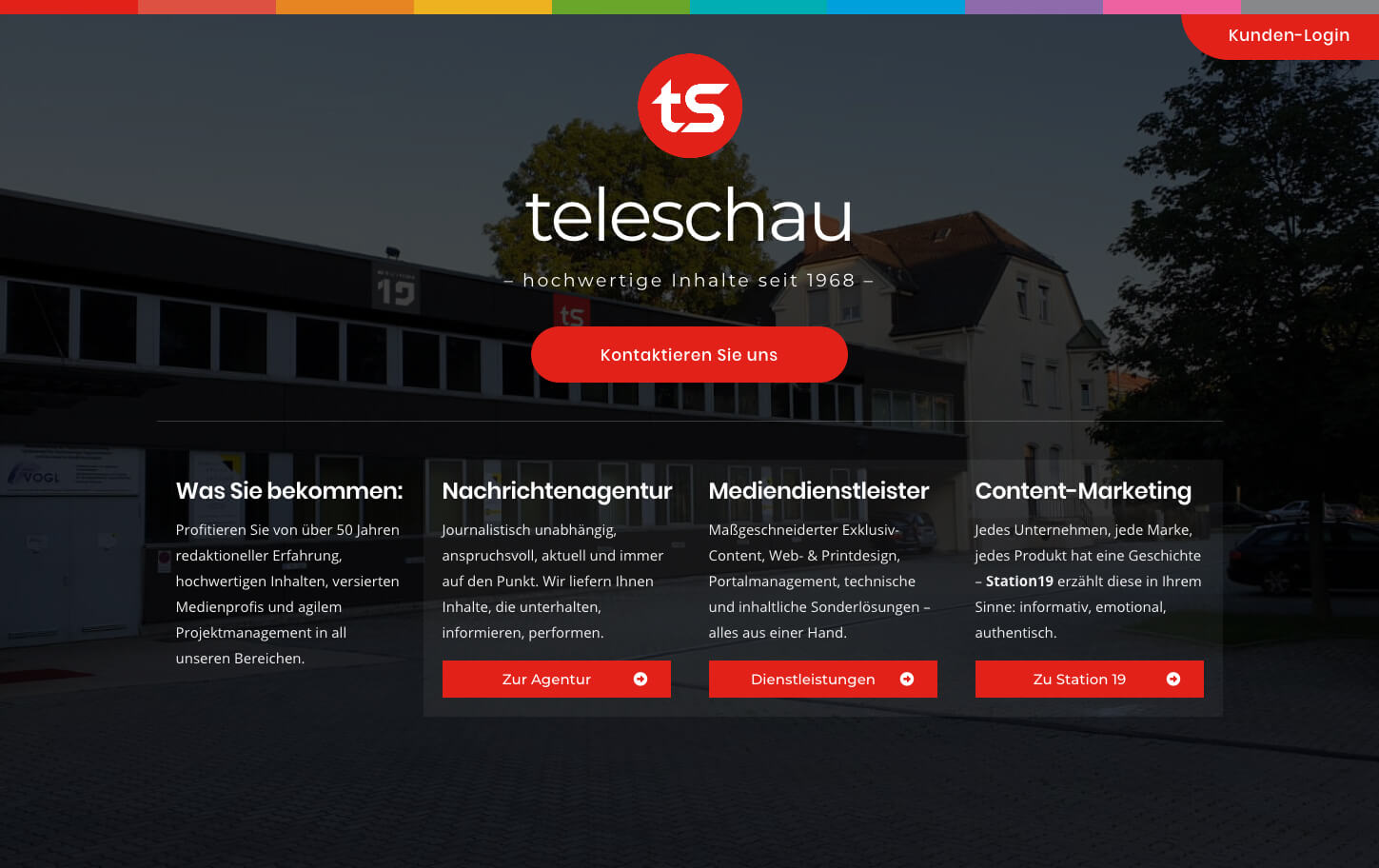
The company presents its offering in three divisions. The first is the Nachrichtenagentur, the news agency proper, which teleschau characterizes as journalistically independent, demanding, current and always to the point, delivering content that entertains, informs and performs. The word "performs" is telling: in the digital media economy, agency content must not only meet editorial standards but also work as online content, attracting readers and holding their attention. The second division is the Mediendienstleister, the media service provider, which produces tailored exclusive content and takes on web and print design, portal management and special technical and editorial solutions, all from a single source. The third is Station19, a storytelling unit built on the premise that every company, every brand and every product has a story, which Station19 tells on the client's behalf in an informative, emotional and authentic way.
This structure reflects how the agency business has evolved. The classic model, selling the same syndicated content to many publishers, still exists, but it has been supplemented by customized production: exclusive content made for a single client, complete portal operations run on behalf of publishers, and corporate storytelling that blurs the line between journalism and communications. teleschau's Munich headquarters at Landsberger Straße 336, 80687 München, reachable at +49/89/143419-0, houses an operation that explicitly markets its agility, its experienced media professionals and its project management alongside its editorial output.
History
The founding year of 1968 places teleschau in a remarkable period of German media history. The late 1960s were the years of the student movement, the Spiegel affair's aftermath, the rise of new journalism and the expansion of the illustrated press and television into mass media. An agency founded in 1968 to supply editorial content to this growing market was responding to a real structural need: as newspapers and magazines multiplied their pages and television expanded its reach, publishers needed more content than their own newsrooms could produce, and specialized agencies stepped in to fill the gap, particularly in entertainment, features and service journalism.
Over the more than five and a half decades since then, teleschau has lived through every transformation of the German media industry. The agency survived the consolidation of the press landscape in the 1970s and 1980s, the arrival of private television in the 1980s, which created entirely new demand for entertainment coverage, the digital revolution of the 2000s, which moved much of the features business online, and the platform era of the 2010s and 2020s, in which content must perform on search engines and social feeds. The company's current self-presentation, with its emphasis on agile project management, portal management and content that "performs", shows an agency that has adapted its language and its services to the digital economy while keeping its founding promise of quality content.
The corporate form, teleschau – der mediendienst GmbH, a limited liability company, is the standard legal vehicle for a German media service business of this type. The addition of "der mediendienst" to the name signals the dual identity: not just an agency but a media service provider. The Station19 storytelling unit represents the most recent layer of this evolution, addressing the corporate communications market directly rather than working only through publishing clients.
Publicly confirmed details about the founders, the ownership structure and the size of the team are not part of the sources consulted for this profile, and this profile does not speculate about them. What is verifiable is the continuity: a Munich media company operating under the teleschau name, at the same Munich address, marketing more than fifty years of editorial experience, and actively offering its services in 2026.
Coverage and Content
The content that teleschau produces as a news agency is the material of the features and entertainment desks. While the company does not publish a public catalog of its current stories in the manner of a newspaper, the nature of its business defines its coverage: interviews and profiles from the world of film, television, music and literature; background and trend stories on popular culture; service journalism on travel, lifestyle, health and consumer topics; and the seasonal and event-driven features, from film festival coverage to holiday specials, that publishers need on predictable schedules.
The agency's self-description emphasizes three qualities for this content: it should entertain, inform and perform. "Entertain" points to the core of the features business: readers choose this content voluntarily, so it must be engaging. "Inform" points to the journalistic standard: even entertainment content must be accurate, current and professionally produced. "Perform" points to the digital reality: on news portals, every piece of content is measured by reach, dwell time and engagement, and agency material must hold its own against everything else on the page. An agency that has survived since 1968 understands that its content is only as good as its usability for the client, which means clean copy, good pictures, clear rights and reliable delivery.
The Mediendienstleister side of the business extends this content production into customized territory. Here teleschau produces exclusive content made to order for individual clients, designs web and print products, manages entire portals on behalf of publishers, and develops special technical and editorial solutions. This is the agency as a white-label newsroom: the client gets the output, teleschau provides the journalists, designers and project managers. Station19, the storytelling unit, takes this one step further into the corporate market, producing narrative content for companies and brands that want to present their stories with journalistic craft, described as informative, emotional and authentic.
Organization and Ownership
teleschau operates as teleschau – der mediendienst GmbH, a German limited liability company headquartered at Landsberger Straße 336, 80687 München. The published contact details are phone +49/89/143419-0 and email marketing@teleschau.de. The company presents itself as drawing on more than fifty years of editorial experience, with seasoned media professionals and agile project management across all of its divisions.
Beyond these verified facts, the sources consulted for this profile do not disclose the names of the managing directors, the ownership structure or the number of employees, and this profile does not invent such details. This is not unusual for a business-to-business media service company, which markets its services to publishers and corporate clients rather than to the general public and has less reason than a consumer brand to publish organizational details. The company's divisions, the Nachrichtenagentur, the Mediendienstleister and Station19, describe the functional organization: editorial content production, customized media services and corporate storytelling, each addressing a different segment of the market.
Digital Presence
The company's website at teleschau.de is its primary public face, and it is designed as a business-to-business presentation rather than a consumer portal. The homepage introduces the tagline "hochwertige Inhalte seit 1968", outlines the three service areas, and provides the Munich address, phone number and email address as the routes to contact. The site's visual identity, including the teleschau logo, presents the company as an established, professional media service house.
Because teleschau's products are delivered to clients rather than to readers directly, its digital presence is necessarily different from that of a newspaper or broadcaster. There is no public news feed carrying the agency's stories under its own brand; the stories appear under the brands of the newspapers, magazines and portals that buy them. The website therefore functions as a shop window and a contact point: it explains what the agency can do, for whom, and how to reach the Munich office. For publishers seeking features content, for companies seeking portal management or design, and for brands seeking storytelling through Station19, the site is the front door to a media service business that has been operating from Munich for more than five decades.